Retired
Overview
There are many benefits to adding a fireplace in our stores to enhance the customer experience including comfort, warmth, and ambience. Before designing a fireplace, make sure you are aware of the following design guidelines and safety procedures.
Overview
There are many benefits to adding a fireplace in our stores to enhance the customer experience including comfort, warmth, and ambience. Before designing a fireplace, make sure you are aware of the following design guidelines and safety procedures.
It is up to the Architect of Record on each project (or Designers in certain parts of the world) to design the fireplace based on current Starbucks guidelines and local jurisdictional standards.
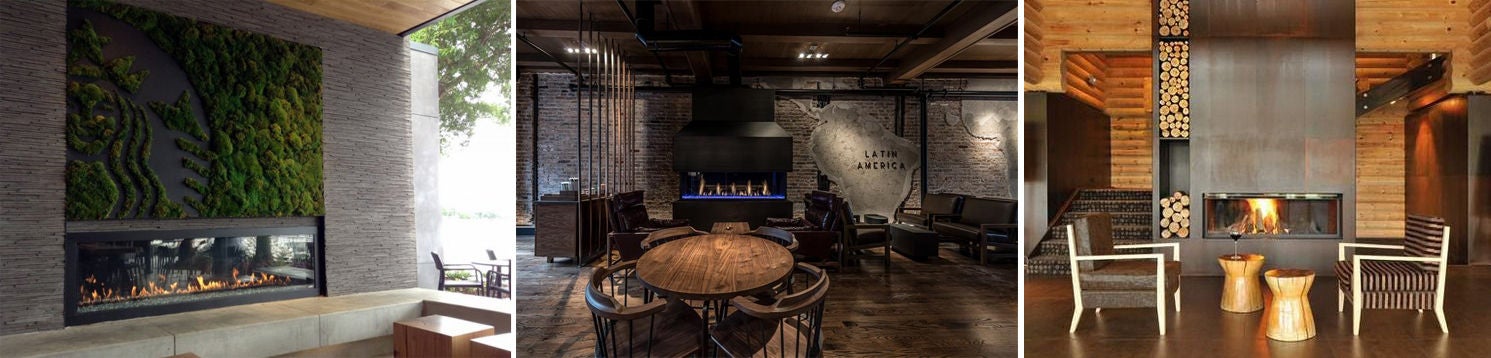
Design Elements
A fireplace creates visual interest and is a natural focal point in any space. Designers can easily alter the look of the fireplace by changed the mantel, mantel shelf, hearth, and surrounding materials. The design can augment the architecture of the space or it can be a unique expression of the design.
It is recommended to choose from materials currently within the Design Catalog, or those which are representative of the Starbucks brand standards. Safety in materials should be of the utmost importance and flammable materials should never be designed or installed around a fireplace.
When placing a fireplace in the design, it is required to be reviewed at the Director level.
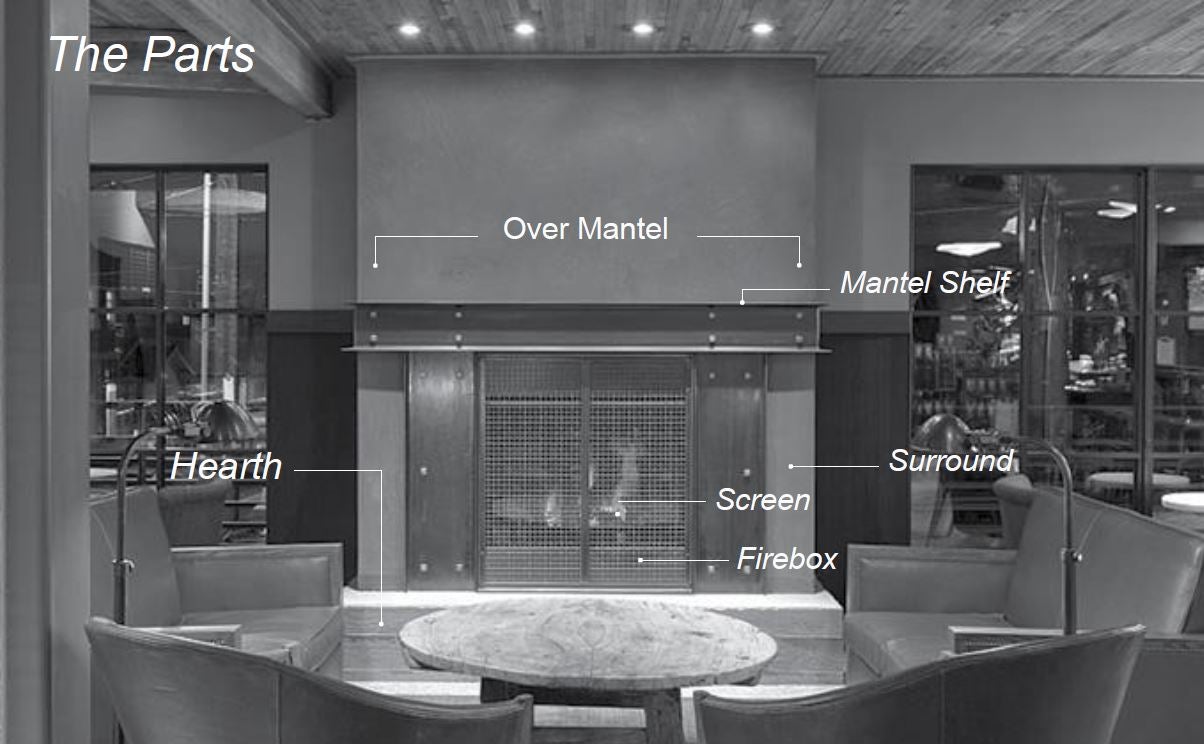
Fireplace: The Parts
- Mantel Shelf: The mantel shelf is above the firebox, often used as a decorative ledge, although it is not necessary and some designers choose not to include them. Various materials can be used, but if the material is flammable, than building codes will dictate the minimum distance between top of the firebox and the mantel.
- Over Mantel: Above the mantel is called the over mantel. Sometimes the surround material is carried to the ceiling, while other times the area receives gypsum wall board and paint.
- Safety Screens: Safety screens are required and must be installed and never removed. Attachable safety screens fasten to the front of the fireplace to create an air space between the glass and the screen.
- Surround: The surround refers to the area around the firebox. This area must have non-flammable materials. For direct-vent sealed units, the clearances are based on the manufacturer's installation recommendations.
- Hearth: The hearth of the fireplace is the portion under the firebox, which generally extends into the room. Most gas fireplaces with fixed glass do not require a hearth extension. Hearths come in many different dimensions and can be raised or flush to the flooring. Refer to manufacturer's specifications for: framing dimensions, clearances to combustibles, and mantel projection requirements.
Heat & Glo Fireplaces
The Starbucks standard for fireplaces is Heat & Glo. All options are direct vent gas fireplaces that offer the following benefits:
- Efficiency: More efficient than traditional gas fireplaces
- Safety: The units are completely sealed from the interior of the building in which they are installed, so no harmful byproducts are released into our cafes; safety screens are required and shall be installed with every unit
- Easy to Install: Can be installed almost anywhere because they can be vented horizontally through an outside wall, or vertically through the roof; unlike traditional fireplaces, direct-vent fireplaces do not need additional masonry, chimney, or foundation work to allow for installation, saving time and money
- Easy to Use: They can be ignited as easily as flipping a switch or using a remote. Each unit comes with a remote that features pilot activations, on/off, 5-step flame hear, fan speed, temperature readout, thermostat mode, timer mode, and child lock, as well a wall docking station so Operations can easily make adjustments as needed
- Environment: They release very little by-product into the atmosphere vs. a wood burning fireplace, thereby contributing to a safe indoor air quality
- Easy to Clean: No wood is required and no cleaning up ashes which benefits the store partner.
Requirements
Fireplaces are designed and specified by the Architect of Record and must comply with all jurisdictional requirements. All surrounding materials and systems must meet or exceed all applicable laws, codes, standards, and regulations in the market in which they will be used. The Architect must ensure the General Contractor is provided with necessary manufacturer and installation instructions. Installation of the unit must adhere strictly to instructions shipped with product.
Before you get started:
- Review the Design Catalog to become familiar with current item specifications
- Review budget impact to ensure a fireplace is appropriate
- Discuss with store operators to ensure they are aware of maintenance requirements, cleaning, and safety
- Do NOT use old specifications or specify wood burning units
- When remodeling a store, replace all units that do not meet or exceed current Starbucks standards
All Starbucks fireplaces must be/have/meet:
Free-standing, vented gas or complete fireplaces ONLY - Cannot be "fireplace insert" unless existing conditions include a wood-burning firebox | All connection piping insulated as required by ASHRAE 90.1 2004 (Required: EAP2) and the prescriptive requirements of the Advanced Energy Nation Design Guide for Small Retail Buildings 2004 (opt. NC EAC1) |
Compliant with ANSI Z21.88 / CSA 2.22 if used as a heat source | No sharp edges, burrs, or projections that could cause injury |
Compliant with ANSI Z21.50 / CSA 2.22 if decorative appliance | No use of any materials containing lead, cadmium, arsenic, or any other toxic heavy metals |
Standing pilot or include electronic pilot ignition | Corrosion resistant or rendered corrosion resistant |
Direct vent compatibility | UL, CL, CUL, CSA certification (or locally required equivalent) |
Installed with a protective barrier - the barrier MUST prevent contact with the glass front and cannot be removed | Installed per manufacturer's directions; all clearances specified by manufacturer are to be observed |
Remote control which is permanently installed adjacent to store thermostat and lighting controls | Installed by NFI-certified installer |
Drawing Requirements
Choosing how to communicate the design intent is as equally important as the finishes themselves. Take the following steps to ensure the unit is installed per design:
- Ensure the unit is designed appropriately for both foot traffic and wheel chair traffic as defined by code
- Clearly dimension the unit, hearth, mantel, and other design features on the drawing
- Ensure the unit itself, as well as decorative elements, are added to the drawing schedule so items can be ordered and installed accordingly
- Properly detail the design to communicate the height, placement of finishes, transitions, materials, and other decorative elements; sheets impacted are floor plan, finish plan, elevations, RCP, details, and MEPs
- Ensure that there is a clear space of 36" [915mm] in front of the unit
- Consider decorative lighting to enhance the over mantel area
- Refer to manufacturer's requirements for mantels, hearths, and surrounds to ensure the design meets the requirements, as well as all applicable codes
- Be sure to consult the manufacturer's installation manual for all details and requirements before making a final design layout decision
- Work with the AOR to determine the final design details to ensure they meet the design intent
- Specify a carbon monoxide (CO) detector near the fireplace
Safety Requirements
While gas fireplaces are a great addition to any store, the glass panel on the front of a gas fireplace can get very hot and remain hot for at least 30 minutes after the fireplace is turned off. Typically it takes 45-60 minutes for the glass front to completely cool down. It is also important to note that materials in close proximity, such as metal surfaces, door frames, and table legs may also get hot to the touch.
In order to keep our customers safe, it is important to keep them from coming in direct contact with the glass. Safety screens are required and must be installed and never removed. Attachable safety screens fasten to the front of the fireplace to create an air space between the glass and screen.
Important Note: Aftermarket safety screens that attach to the fireplace, stove, or insert could adversely affect the safe operation of the unit. Contact the safety screen manufacturer to verify that the safety screen is approved for the product. If the manufacturer and model number are known, contact the manufacturer first, as they may have a safety device specific to that unit.
Proper maintenance is key to safety and longevity. Ensure the following steps have been taken in the store assessment:
- Proper fitting of safety device is important, so speak to an expert
- Keep remote control (if applicable) out of reach of children and customers
- All gas-fired, certified fireplaces manufactured after January 1, 2015, will include a safety screen that must be installed
- Always read the owner's manual and follow the instructions to ensure the unit is always working properly
- The gas fireplace should be inspected by a trained professional that has been certified by the manufacturer
- Daily store cleaning and operations may include stacking furniture and chairs, which should never be in close proximity to the fireplace
- A carbon monoxide (CO) detector is required by Starbucks to be installed near any gas fireplace to detect potential gas leaks
- Ensure the unit is turned off when not in use
In an effort to increase project safety, the fireplace industry (HPBA.org) together with the CPSC, have elected to impose a requirement that all gas front fireplaces, stoves, and inserts sold after January 1, 2015, must include a safety barrier. The requirement will be enforced through code compliance per ANSI Z21.88. Safety barriers have been a standard feature on Heat & Glo fireplaces since 2003, which is why Starbucks has chosen their products as our specification. Screens are available in black, bronze, and pewter.
For more information, see Fireplace Safety Tips from HPBA, Replacement Screens through Heat & Glo, or information on the Safety Mandate for Glass Front Fireplaces.
Cleaning and Maintenance
The fireplace assembly should meet these performance and product requirements:
- Will be in frequent contact with chlorine and quatemary ammonium based foodservice sanitizers
- Will be exposed to commercial cleaning equipment on periodic basis
- Fireplace is operating correctly with any control points such as flame settings, thermostat settings, on/off controls, fan settings, or timers working properly
- Glass and surround are free of spills and splatters with no dirt, dust, debris, or build up and with no rough or sharp edges
- Body panels, hinges, access panels, and latches shown minimal damage and are working properly
- Burner assembly is free of dust/debris and inserts are in place
- Hearth and mantel are secured properly with no danger of falling
- Any items displayed in areas are appropriately sized with no danger of falling from area
- Screening is free from damage of any kind and free of dust/debris; mounting is secure
- Gas shut off valve is accessible and in good condition
- Clean ability: ASTM C756
- Resistance to surface abrasion of cleaners: CSPA DCC-15
- Resistance to change from cleaners: ASTM D1308
- Presence of black soot on glass indicates that fireplace needs to be serviced
- Presence of cracks in the glass indicate that glass is weakening and needs to be replaced
Heat & Glo gas fireplaces are easy to maintain since there is no wood or ashes, but proper installation and routine maintenance are essential to fireplace safety, as well as the ability to burn clean and green. To ensure top performance, a gas fireplace should be serviced once a year by a certified professional who can inspect the burner, fan, vents, pilot light, thermostat, and clean the glass. Starbucks Facility Managers should become familiar with and schedule these maintenance requirements when a fireplace is designed within one of their stores.
Coffee and other hot and cold beverage spills on the fireplace will required cleaning in addition to yearly maintenance. Operators should follow the Store Cleanliness and Equipment Maintenance Manual instructions which state that the unit must be fully cleanable by hand with a bar towel and hand (no special tools). The operators should always ensure that the unit has been turned off and completely cooled down before coming into contact for cleaning.

